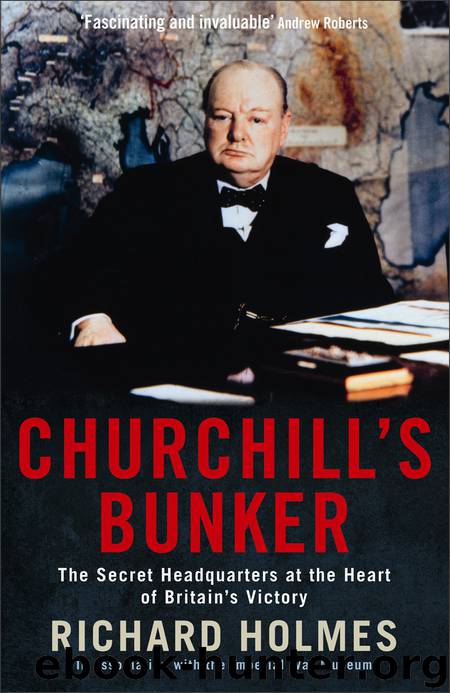
Churchill's Bunker by Richard Holmes
Author:Richard Holmes
Language: eng
Format: epub
Publisher: Profile
Published: 2011-12-10T16:00:00+00:00
The reshaping of the CWR
As a secure meeting place for the War Cabinet, the underground rooms had their heyday in the autumn and winter of 1940–41. Thereafter the War Cabinet usually met at 10 Downing Street or the House of Commons, with perhaps 115 sessions, about one in ten of its meetings, being held in the War Rooms during the course of the war. The chiefs of staff also preferred to meet elsewhere, usually upstairs in the NPO, after the worst of the Blitz was over.
The need for secure accommodation became important once more in 1943 as, although the Luftwaffe was no longer considered to have the resources to mount another Blitz, information arrived in August that Germany was preparing a new attack, this time using the V-weapons – flying bombs and rockets. Once more the suitability of the NPO as the command centre of the war was questioned. The Crossbow Committee was set up to evaluate defences against the new weapons and to ensure that the machinery of government could be kept running. It decided against reviving the ‘Black Move’ but recommended that citadel accommodation be investigated.11 It was clear that the CWR was not safe against a 1100 lb bomb with a delayed-action fuse, and a survey of available citadels pointed to the Horseferry Road rotundas as the most suitable. Two possible options identified in late 1943 were:
(a) That the Cabinet Office continues to work where it is now, using the downstairs accommodation when there is a blitz, but that the PM, after dark, should be in say the citadel in Horseferry Road connected to the Cabinet Office by tunnel. Meetings of ministers or COS after dark would take place there.
(b) That the main business of the Cabinet Office transplants itself to the new citadel in Horseferry Road.12
In the end neither plan was implemented and the Cabinet Office continued to work where it was. When the attack by V1 flying bombs began in June 1944 the War Cabinet began to meet in the CWR once more, and held many meetings there until September, when fewer of the V1s were getting through. The risk had certainly been great. On 8 June a V1 hit the Guards Chapel on Birdcage Walk when it was packed for morning service: 122 of the congregation were killed and 141 seriously injured. But the first V2 rocket hit England on 8 September, and as the risk increased so the Cabinet often met underground until after the last V2 reached London on 28 March 1945.
From 1941 a number of factors changed both the configuration of the War Rooms and the use made of them. Increasingly rooms doubled up as emergency accommodation for senior personnel who worked mainly upstairs, space was vacated as Home Command HQ moved first to the CWR Annexe, where the Churchill Museum is today, and then on to Horseferry Road, and extra accommodation was required as the number of sections and committees under the umbrellas of Joint Planning and Joint Intelligence grew.
Rooms in the original basement were re-allocated.
Download
This site does not store any files on its server. We only index and link to content provided by other sites. Please contact the content providers to delete copyright contents if any and email us, we'll remove relevant links or contents immediately.
Fanny Burney by Claire Harman(26607)
Empire of the Sikhs by Patwant Singh(23090)
Out of India by Michael Foss(16861)
Leonardo da Vinci by Walter Isaacson(13341)
Small Great Things by Jodi Picoult(7156)
The Six Wives Of Henry VIII (WOMEN IN HISTORY) by Fraser Antonia(5519)
The Wind in My Hair by Masih Alinejad(5103)
A Higher Loyalty: Truth, Lies, and Leadership by James Comey(4967)
The Crown by Robert Lacey(4820)
The Lonely City by Olivia Laing(4808)
Millionaire: The Philanderer, Gambler, and Duelist Who Invented Modern Finance by Janet Gleeson(4482)
The Iron Duke by The Iron Duke(4367)
Papillon (English) by Henri Charrière(4278)
Sticky Fingers by Joe Hagan(4207)
Joan of Arc by Mary Gordon(4117)
Alive: The Story of the Andes Survivors by Piers Paul Read(4037)
Stalin by Stephen Kotkin(3973)
Aleister Crowley: The Biography by Tobias Churton(3646)
Ants Among Elephants by Sujatha Gidla(3470)
